
SEO Audit for Small Business Websites in Cheyenne: What to Fix First
If your website is not ranking well, not getting enough local traffic, or not converting visitors into leads, this guide explains the first SEO issues small businesses in Cheyenne should fix for better results.
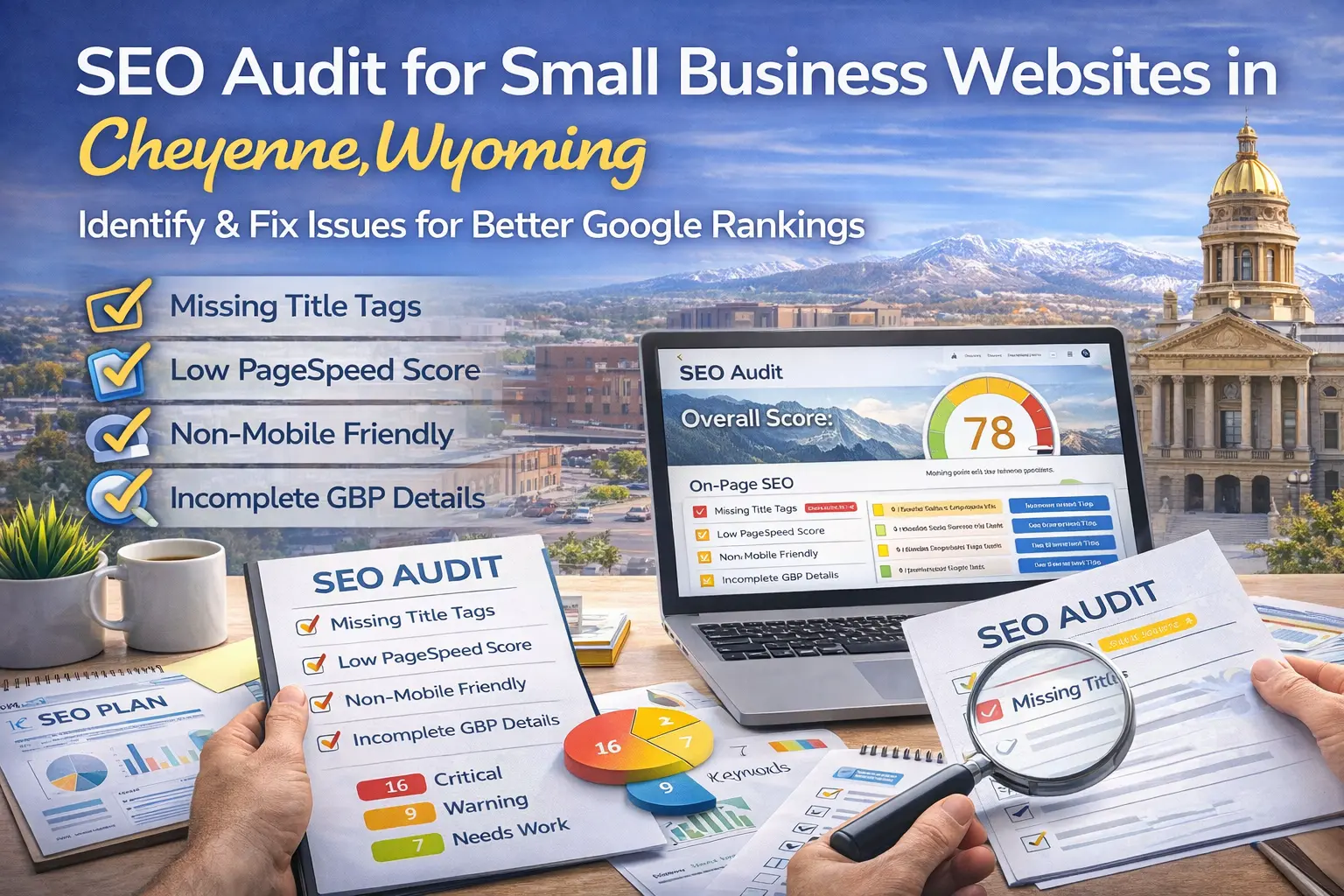
Good SEO audits focus on practical fixes with real impact
The most useful audit is not the longest checklist. It is the one that identifies what is hurting visibility, trust, and lead generation first.
An SEO audit for small business websites in Cheyenne helps identify the issues that stop your website from ranking better, attracting local visitors, and generating more leads. If your site looks decent but still is not performing well, the problem often lies in the structure, content, speed, or local SEO foundation.
Many small business websites have hidden issues that are easy to overlook. These include weak page titles, poor heading structure, thin service content, missing internal links, slow mobile performance, and unclear location relevance. Even one of these issues can weaken your ability to compete in search.
In this guide, we will look at what a practical SEO audit should focus on first, especially for local businesses in Cheyenne, Wyoming that want better rankings, stronger visibility, and more qualified inquiries.
What an SEO Audit Actually Does
An SEO audit reviews the parts of your website that influence search performance and user experience. The goal is not only to find problems. It is to prioritize the issues that matter most and create a clear direction for improvement.
A good audit should connect technical SEO, on-page SEO, content quality, internal linking, local relevance, mobile usability, and conversion-focused design. It should also show how your website supports or weakens your wider local business growth strategy.
- Checks page titles, headings, and metadata
- Reviews service content and keyword targeting
- Evaluates mobile usability and loading speed
- Identifies weak internal linking and page structure
- Looks at local SEO relevance and location signals
- Highlights conversion issues that reduce leads
Fix Page Titles and Meta Issues First
Page titles are one of the first things search engines and users see. If titles are missing, duplicated, too weak, or too generic, your website may struggle to communicate relevance. Meta descriptions may not directly control rankings, but they can influence clicks when your page appears in search.
Many small business websites either ignore titles completely or use the same structure on every page. Each important page should clearly reflect its unique purpose, service relevance, and local context where appropriate.
Improve Heading Structure and Content Clarity
A page with weak headings often feels unclear to both users and search engines. Your H1 should state the core topic of the page, while H2 and H3 headings should organize supporting sections in a logical way. This helps readability, topical clarity, and SEO structure.
Clear headings also support better service-page performance. This matters especially when your website connects to important pages like services, website design and development, and SEO services.
Simple audit truth
A website can look visually fine and still perform poorly in search if the content structure is weak, vague, or not aligned with real user intent.
Find Thin Service Pages and Content Gaps
Thin pages are one of the most common problems in small business SEO. A page that says very little about what you offer is harder to rank and less convincing for visitors. Service pages should explain the service clearly, build trust, answer common questions, and guide users toward action.
A good SEO audit should identify pages that need better depth, stronger keywords, clearer messaging, and more useful internal links. Strong content helps both rankings and conversions.
Check Internal Links and Page Priority
Internal links help search engines understand which pages matter and how your topics connect. They also help users move deeper into the website. Many small business sites miss this opportunity by leaving key pages isolated or underlinked.
A strong internal linking structure should naturally connect blog content with important conversion pages such as pricing, contact, why choose me, and my process.
Audit Mobile Speed and User Experience
Mobile performance is one of the most important parts of an SEO audit. Many local users visit a business website from their phones first. If your site loads slowly, feels cluttered, or is hard to use on mobile, users may leave before taking action.
Mobile audits should look at image size, spacing, text readability, button usability, layout shifts, and general speed. A faster, clearer mobile experience supports both search performance and lead generation.
Review Local SEO Signals
For businesses in Cheyenne, an SEO audit should also check local relevance. Your website should make it clear what services you offer and where you offer them. This includes local intent in content, location-aware service pages, consistent contact information, and alignment with your business profile.
Local SEO usually works best when your website supports your Google visibility through content, structure, and trust. That is why audits should also look at how your site complements your local presence and overall online brand.
Check Conversion Barriers, Not Just Rankings
SEO traffic only matters if it can turn into business results. A good audit should check whether visitors can understand your services, trust your business, and contact you easily. If the website ranks but does not convert, your growth is still limited.
Review call-to-action placement, trust-building sections, service clarity, form usability, and navigation flow. This is where SEO and design overlap closely, especially through pages like portfolio, projects, and branding and graphic design.
Common Issues Small Businesses Should Fix First
Some problems are more urgent than others. While every website is different, certain issues usually deserve fast attention because they weaken visibility and lead generation more directly.
- Missing or weak page titles: Search relevance becomes less clear.
- Thin content: Pages struggle to rank and build trust.
- Poor mobile experience: Users leave before engaging.
- Weak internal links: Important pages receive less support.
- Unclear local relevance: Your location and service signals feel weak.
- No conversion path: Visitors are unsure what to do next.
Why Prioritization Matters in an Audit
An SEO audit is most useful when it helps you focus on the right issues first. Some websites have dozens of minor technical notes, but only a few issues may be seriously affecting performance. Fixing high-impact problems early often delivers better results than trying to solve everything at once.
Small businesses usually benefit most from fixing structural content issues, local relevance gaps, internal linking weaknesses, and mobile usability problems before worrying about lower-impact details.
Final Thoughts: A Good SEO Audit Should Lead to Better Decisions
An SEO audit for a small business website in Cheyenne should not feel like a technical report full of random notes. It should help you understand what is holding your website back and what changes can create the strongest improvement in search visibility, usability, and leads.
When the right issues are fixed first, your website becomes easier to understand, easier to rank, and easier to trust. That creates a better experience for both search engines and real customers.
If your site feels outdated, underperforming, or disconnected from your SEO goals, a practical audit can be the right first step toward stronger local results.
Need help auditing and improving your small business website SEO?
Pak Web Expert helps businesses identify high-impact SEO issues, improve local relevance, strengthen service pages, and build websites that support both rankings and real lead generation.
Frequently Asked Questions
An SEO audit usually includes checking title tags, meta descriptions, heading structure, content quality, internal links, mobile usability, page speed, local SEO signals, crawlability, and conversion-focused elements.
You should usually fix the highest-impact issues first, such as missing page titles, weak service content, broken internal links, poor mobile usability, slow loading pages, and unclear local relevance.
Mobile speed matters because many users visit from phones first. Slow mobile pages create poor user experience, reduce engagement, and can hurt search performance and lead generation.
Yes. An SEO audit can improve local rankings by identifying issues in Google Business Profile alignment, local content relevance, service pages, on-page SEO, internal linking, and overall website usability.